Published:2026-09-14 09:00:00
Fixed-end support-unit service
Identify the cause before choosing the repair
A preloaded fixed end is an adjusted assembly. When axial movement, noise or temperature changes appear, check external joints and alignment first, then determine whether the bearing set or complete support unit needs replacement.
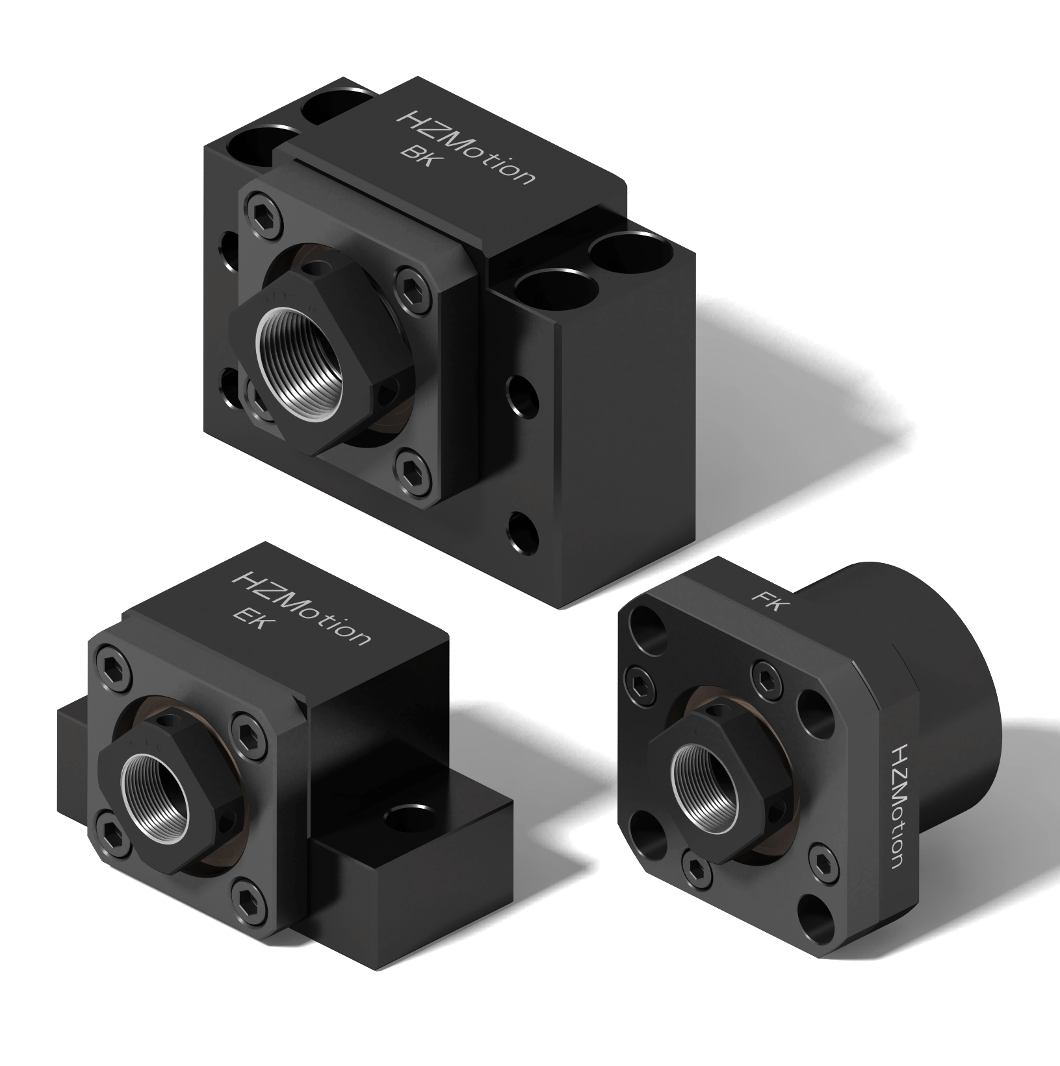
01 / The assembly
A repair must restore the operating condition of the complete bearing set
A fixed-end support locates the ball screw axially. In a factory-preloaded assembly, bearing selection, orientation, contact faces, collars, covers, seals and lubrication all contribute to its installed behaviour. Reassembling parts by appearance alone does not establish that the original preload or accuracy has been restored.
The HZMotion support-unit manual instructs users not to dismantle the fixed-end unit during normal installation and use because this can disturb preload. It also states that the supplied unit already contains grease. Internal repair requires a procedure for the specific assembly.
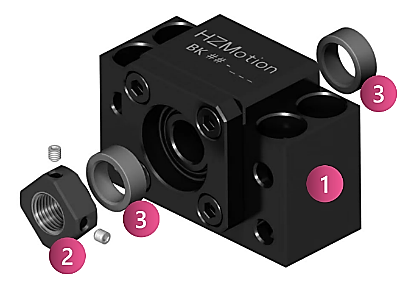
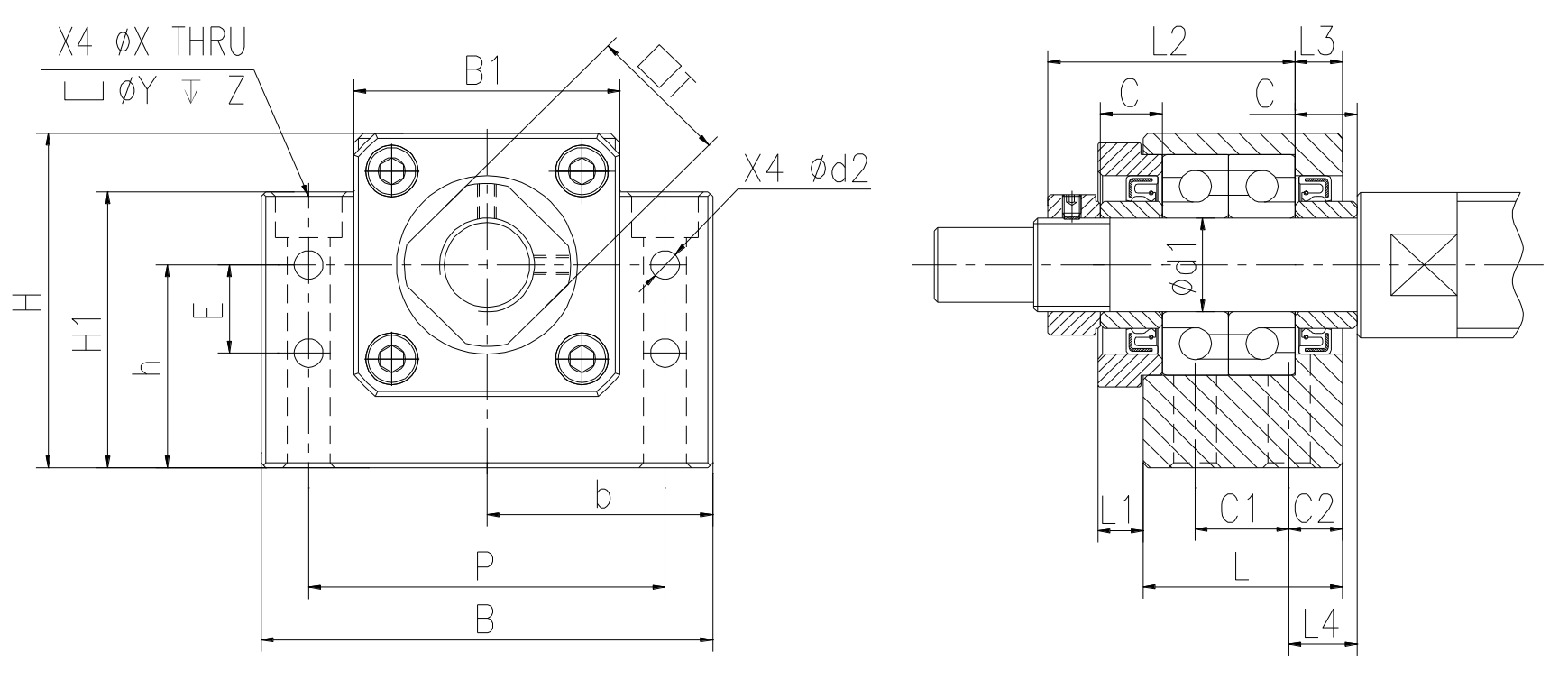
This guide concerns preloaded fixed-end assemblies. Economy deep-groove configurations, floating support ends and custom designs require their own instructions.
02 / Clamping and location
Mounting bolts, the shaft locknut and internal preload have different functions
| Part | Function | Service boundary |
|---|---|---|
| Housing mounting bolts | Secure the housing to the machine base and maintain the mounting relationship. | Align and tighten according to the assembly procedure, then remeasure. Do not pull a misaligned housing into position with its bolts. |
| Shaft locknut and locking devices | Seat the shaft, inner rings, collars and other axial locating parts correctly. | Use the specified tightening and locking procedure. The nut is not a general-purpose preload adjustment control. |
| Bearing set, internal spacers or cover | Establish the controlled internal locating and preload arrangement; details vary by design. | Identify the configuration and repair procedure before loosening, swapping or machining parts. Do not improvise shims to obtain a preferred hand feel. |
Locknut tightening torque is not the bearing preload force. The HZMotion manual notes that excessive clamping in some DF arrangements can reduce preload between the bearings. Tightening the nut further is therefore not a universal remedy for measured axial movement.
03 / Before dismantling
Find which operating or assembly change triggers the symptom
Record the full part number, when the symptom started and the operating conditions. Before disconnecting a coupling or releasing a joint, isolate power and securely support components that could move or fall, following the machine service procedure.
| Observation | Check first | Do not conclude yet |
|---|---|---|
| Rotation becomes heavier after housing bolts are tightened | Mounting surfaces, hole positions, support heights and screw-to-guide alignment. | This does not by itself prove bearing damage; assembly stress can also increase resistance. |
| Current or vibration rises after connecting the coupling | Alignment, shaft extensions, shaft-end gap, clamping positions and motor condition. | Replacing only the support unit may leave the external constraint unchanged. |
| Axial movement or knocking on reversal | Locknut, collar seating, housing joints, ball nut and coupling connections. | An indicator reading can include several loose joints and elastic deflections, rather than bearing clearance alone. |
| Temperature is higher than previously | Trends at comparable speed, load and ambient temperature; seals, lubrication and recent assembly changes. | One temperature reading does not identify preload, contamination, lubrication or alignment as the cause. |
| Periodic roughness remains after external constraints are excluded | Have service personnel assess the bearing and mating surfaces. | Sound alone cannot locate damage or justify replacing an individual bearing. |
Compare cold and warm conditions, both directions, coupling connected and disconnected, and before and after final tightening. Keep speed, load and measurement positions comparable.
04 / Matching and preload
Equal boundary dimensions do not establish an equivalent bearing set
Check bearing type, contact angle, accuracy class, preload, arrangement and sealing. Bore, outside diameter and width describe only the envelope.
Preserve the specified arrangement and matching marks. Similar-looking internal spacers are not automatically interchangeable.
Shaft and housing fits, locating faces, contamination and temperature differences affect the assembly and require a final check.
NSK explains that the order and orientation of matched angular-contact bearings are part of their preload setting. SKF describes how interference fits, mounting geometry and temperature influence installed preload. Free rotation after fitting an equal-sized bearing is therefore an incomplete repair check.
Universally matchable bearings also have manufacturer-specific compatibility rules. Do not assume that an old bearing can be mixed with a new one. Any such replacement needs the applicable matching rules and approval for the complete assembly.
For the distinction between accuracy, preload and suffixes, see the bearing-code guide. For heavy-duty load directions, see DF, DB, DFD and DFF arrangements.
05 / Repair decision
Choose the repair scope from the condition and available verification
| Path | Suitable conditions | Required confirmation |
|---|---|---|
| Correct external assembly; retain the unit | The symptom is traced to alignment, a joint or incorrect locking, without evidence of internal damage. | Geometry, axial location and trial-run results recover and meet machine requirements. |
| Replace the matched bearing set under a repair procedure | The bearing is the identified fault; housing seats, locating faces and shaft are serviceable; configuration, parts and inspection capability are available. | Qualified personnel restore the specified arrangement, sealing and lubrication and verify the complete unit. |
| Replace the complete fixed-end unit | Housing or locating-face damage affects function, the internal configuration is untraceable, or proper rebuilding and inspection are unavailable. | Check the new full designation and shaft interface. A replacement housing does not repair a damaged screw journal. |
| Obtain a manufacturer or specialist repair assessment | Heavy-duty, multi-row, special-preload or custom units have an uncertain damage scope or repair cost. | Agree repairable features, replacement parts, acceptance checks, lead time and responsibility before deciding. |
Compare parts, labour, inspection, downtime and the risk of repeat failure together. A sound assembly need not be replaced simply for convenience, but the purchase price of two bearings is not a complete repair-cost comparison.
06 / Service information
Establish the original configuration before choosing a replacement
- Preserve identificationPhotograph the complete designation and suffixes. Keep the order, drawing revision, orientation, operating conditions and fault history; “BK15” alone is insufficient.
- Inspect adjacent partsCheck the screw journal, shoulder, locknut thread, collar, housing bore and machine base against controlled dimensions and geometric requirements.
- Define the repairSpecify who will perform the work, the bearing set and seals, lubricant and quantity, tooling and final inspection.
- Protect seats and sealsAvoid impact or forced assembly and incorrect mounting forces through rolling elements. Protect seal lips and prevent contamination.
- Resolve the initiating causeAddress contamination, lubrication, overload, thermal conditions or external alignment so the same issue is not carried into the new assembly.
If a dismantled unit has lost its arrangement, spacer or suffix records, treat it as an unconfirmed configuration for supplier or repair-engineering assessment. Do not assume factory performance has been recovered.
07 / After repair
Check geometry and running behaviour after confirming that the shaft turns
| Stage | Checks | Record |
|---|---|---|
| Assembly complete | Shaft radial runout, axial location, mounting datums and smooth travel. | Measurement position, instrument, applied test load, coupling state and the source of acceptance limits. |
| Staged trial run | Temperature, current, noise and vibration from low speed to approved duty. | Speed, load, ambient conditions and time trends. Pause escalation if abnormalities appear. |
| Cool-down and recheck | Axial location, fastening condition, repeatability and cold/warm differences. | Confirm no continuing deterioration or irreversible drift; retain before/after results. |
Preload cannot be established from hand feel, coast-down time or one current reading. Use the method specified for the bearing or assembly when preload verification is required. Agree missing acceptance limits with engineering before returning the axis to service.
Continue with the measurement states and record format in the support-unit installation acceptance checklist.
08 / FAQ
Frequently asked questions
Is removing the unit from the machine the same as dismantling its bearings?
No. Releasing the external mounting is distinct from opening the bearing set. Removal and refitting still require the specified shaft-locking, support and alignment procedure without forced pulling.
Can I replace only one bearing of the same size?
Size alone is insufficient. Check arrangement, contact angle, accuracy and preload compatibility. Evaluate the matched set rather than assuming a mixture of old and new individual bearings is acceptable.
Will tightening the nut fix increased axial movement?
First identify where the reading comes from. A loose joint may need the prescribed correction; raceway damage, a wrong configuration or mounting error cannot be fixed by simply tightening further.
Will more grease reduce the temperature?
Not necessarily. Do not add or mix grease arbitrarily in a prefilled assembly. Identify the cause and follow the specific lubrication quantity and interval.
Should I replace the bearings again if a new unit still vibrates?
Recheck the motor, coupling, screw end, base alignment and operating conditions. Replacing the unit does not verify the complete axis.