Published:2026-08-28 09:30:00
Accuracy codes and support-unit configurations
The same C5 label in two catalogs may describe completely different features
A ball-screw C grade, bearing P class, support-unit suffix, preload and DF/DB arrangement evaluate different objects. Calling all of them an “accuracy grade” can select the wrong bearing, preload or housing configuration.
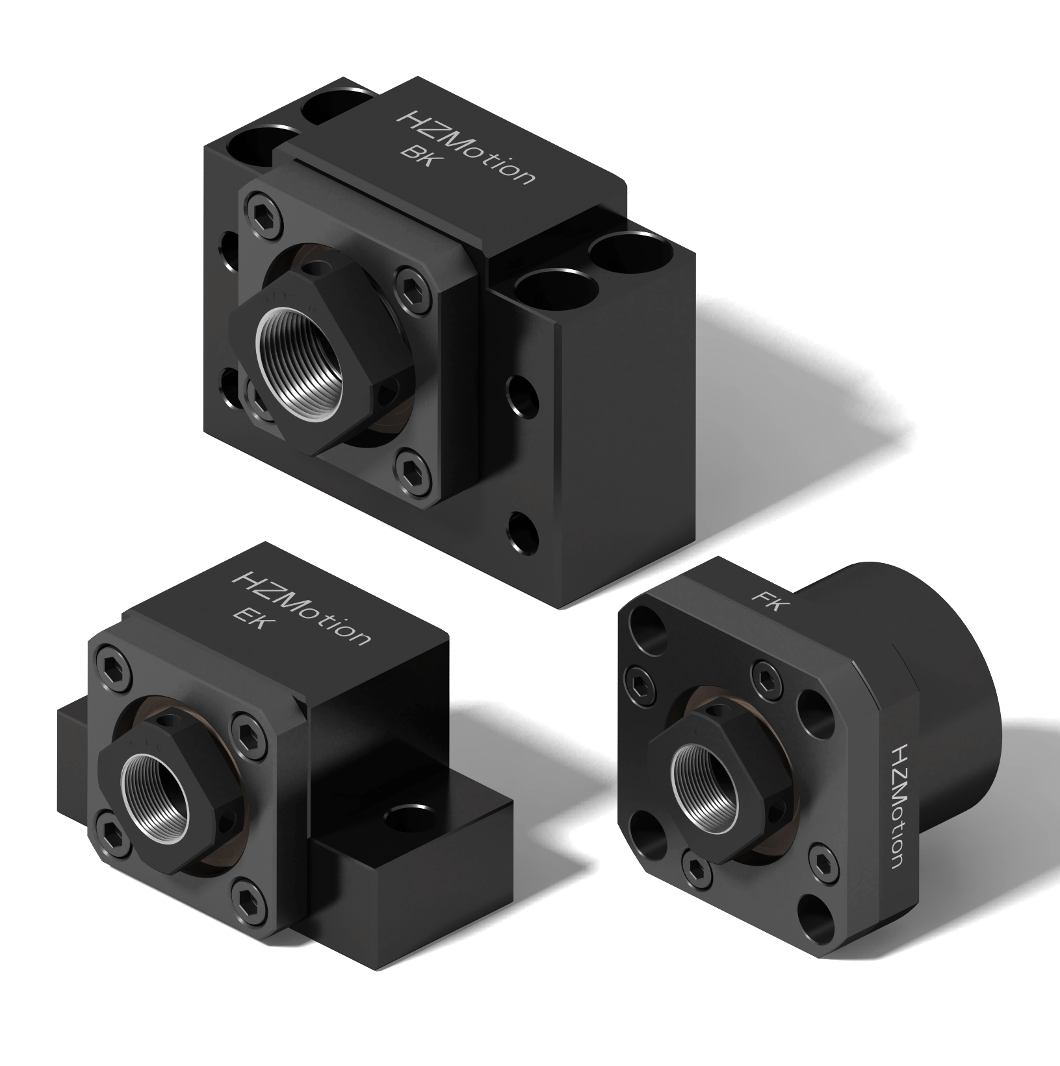
01 / Separate the objects
Five terms do not form one low-to-high accuracy ladder
| Term | Object | Main influence | Does not define |
|---|---|---|---|
| Ball-screw C3/C5/C7 | Lead accuracy over travel | Positioning error and compensation boundary | Bearing class, preload or total backlash |
| Bearing P4/P5/P0 | Bearing dimensional/running accuracy | Rotational accuracy and assembly consistency | Housing datum accuracy or screw lead |
| Light/medium/heavy preload | Initial internal axial load | Stiffness, friction, temperature and starting torque | Ball-screw lead accuracy |
| DF, DB and multi-row arrangements | Contact-line orientation and row count | Rigidity, load sharing and alignment sensitivity | An accuracy grade |
| Support-unit grade/suffix | Supplier-defined assembly bundle | Selection, price and operating boundary | A universal cross-brand conversion |
Core rule: identical suffixes do not prove identical internals, and different suffixes do not necessarily change mounting dimensions. Identify the object being graded first.
02 / Ball-screw C grade
C3, C5 and C7 describe lead accuracy—not simply backlash
Ball-screw manufacturers define C grades through the applicable JIS, ISO, DIN or catalog system, using representative travel error, travel variation over a specified length or related lead-accuracy limits. The grade describes actual versus theoretical travel.
Positioning-error budgets, compensation strategy, measurement planning and lead-accuracy selection.
Ball-nut preload, support-bearing stiffness, coupling error, alignment or total system backlash.
Confirm the standard, effective travel, evaluation length, temperature and exact error definition.
A C3 ball screw therefore does not universally require a support unit carrying a C3 suffix. Use the supplier configuration table and complete system duty.
03 / Bearing P class
P4, P5 and P0 classify the bearing; they cannot be translated directly to C4, C5 and C0
Within the same bearing standard, P4 is generally more stringent than P5 and P0 is a normal class. These classes address bearing dimensional and running accuracy. Housing datums, bore fits, shaft-end runout, locknut clamping and assembly alignment remain system issues.
Why the labels can appear paired
A supplier may define a C4 support-unit configuration containing P4 bearings. HZMotion currently does so in its C4 option.
Why it is not a conversion formula
It is a supplier product definition. HIWIN, SYK and HZMotion do not bundle exactly the same bearings, preload, housing tolerances or origin under every C suffix.
Write “this supplier's C4 configuration contains P4 bearings,” not “C4 equals P4.”
04 / Preload and arrangement
More preload raises stiffness—and also friction, temperature and starting torque
Preload is the initial axial loading/clearance state inside a bearing pair. Appropriate preload reduces internal play and raises axial stiffness. Excessive preload increases friction and heat and can reduce life. It should not be increased informally with the locknut.
| Concept | Meaning | Engineering boundary |
|---|---|---|
| DF face-to-face | Contact lines converge inward | An arrangement code, not zero backlash or an accuracy class |
| DB back-to-back | Contact lines spread outward | Different moment rigidity and alignment sensitivity; use supplier data |
| DFD / DFF etc. | Multi-row/group arrangements | For greater load/rigidity; capacity cannot be inferred from letters alone |
| Light/medium/heavy preload | Different initial internal loads | Check speed, heat, life, starting torque and duty together |
HZMotion fixed-end assemblies are factory preload-adjusted and grease filled. Do not disassemble them or use the locknut as an informal preload adjustment.
05 / Current HZMotion configurations
One housing family can be ordered with different internal configurations
| Current web grade | Bearing | Bearing class | Preload | Origin | Common arrangement | Suggested screw grade |
|---|---|---|---|---|---|---|
| Blank | Angular-contact | P0 | Light | JP | DF | C3–C7 |
| C5 | Angular-contact | P5 | Light | CN | DF | C3–C7 |
| C4 | Angular-contact | P4 | Medium | CN | DF | C1–C3 |
| TAC5 | 60° thrust angular-contact | P5 | Heavy | CN | Usually DF | C3–C7 |
| TAC4 | 60° thrust angular-contact | P4 | Heavy | CN | Usually DF | C1–C3 |
| E | Deep-groove | Not stated in current table | Light-duty economy | JP | Verify model | C7–C10 |
Two boundaries: suggested screw grades are selection guidance; they do not give the support unit ball-screw lead accuracy. Current web tables and inventory part numbers may use both a blank grade and a C3 identifier for the imported standard configuration. Confirm the complete part number, bearing details and quotation.
AK and LK currently have no TAC option. Heavy-duty WBK, SBK, FBSA and MBK may also use DF, DB, DFD, DFF, QBC or QFC arrangements and require separate review.
06 / Safer selection sequence
Select screw lead accuracy first, then place the bearing configuration inside the load and thermal duty
- Determine ball-screw lead accuracyUse the positioning-error budget, compensation strategy, effective travel and measurement conditions.
- Select the housing familyUse shaft-end drawing, mounting datum, center height and envelope to filter BK, EK, FK, AK or LK.
- Select bearing typeUse peak/mean axial load, speed, shock, duty, temperature and life.
- Select P class and preloadBalance rigidity and running accuracy against starting torque, heat and life.
- Select bearing arrangementChoose DF, DB or multi-row configurations from load direction, moment, space and alignment sensitivity.
- Verify the complete part numberConfirm housing datums, bearing-seat tolerances, fixed/supported pairing, surface treatment and accessories.
07 / Three examples
A higher class cannot correct an inaccurate system foundation
Do not automatically choose any product carrying a C7 suffix. Compare standard and economy options against load, speed, temperature and life.
A P4/C4 option may help, but a higher bearing class cannot correct a poor datum, shaft-end runout or ball-screw lead error.
Review contact angle, allowable axial load, preload, life and multi-row arrangement. Changing a standard unit from C5 to C4 is not a heavy-load design review.
Include in the RFQ: ball-screw manufacturer/model, C grade, diameter and shaft-end drawing, support arrangement, peak/mean axial load, maximum speed, duty/temperature, target accuracy and life.
08 / Quick answers
Accuracy-code questions
Must a C3 ball screw use a C3 support unit?
No universal cross-brand suffix rule applies. Use the support-unit supplier's configuration table and the system accuracy, load, speed, temperature and life requirements.
Does a P4 bearing make every assembly a C4 support unit?
No. HZMotion currently uses P4 bearings in C4 configurations, but this is a product definition rather than an industry conversion.
Is heavier preload always better?
No. It raises stiffness but also friction, heat and starting torque, and can affect life.
Does DF guarantee zero system backlash?
No. DF describes bearing orientation. The full axis also includes the ball nut, coupling, housing, locknut and mounting interfaces.
Should the supported end use the same preload logic?
Usually not. A standard supported end commonly uses a deep-groove bearing for radial support and must be checked against its own table and axial condition.
Are BK15-C5 units from different brands interchangeable?
Not from the suffix alone. Confirm dimensions, bearing type, housing tolerances, preload, shaft-end geometry and accessories.