Published:2026-10-19 12:00:00
Updated:
Support and mounting components · Environment
Start with the water that actually reaches the machine
Once a transmission assembly leaves a dry assembly bench, it meets the conditions of the workshop: coolant, condensation and cleaning. Describing that exposure early lets designers turn corrosion protection into clear requirements for materials, surfaces, interfaces and maintenance.
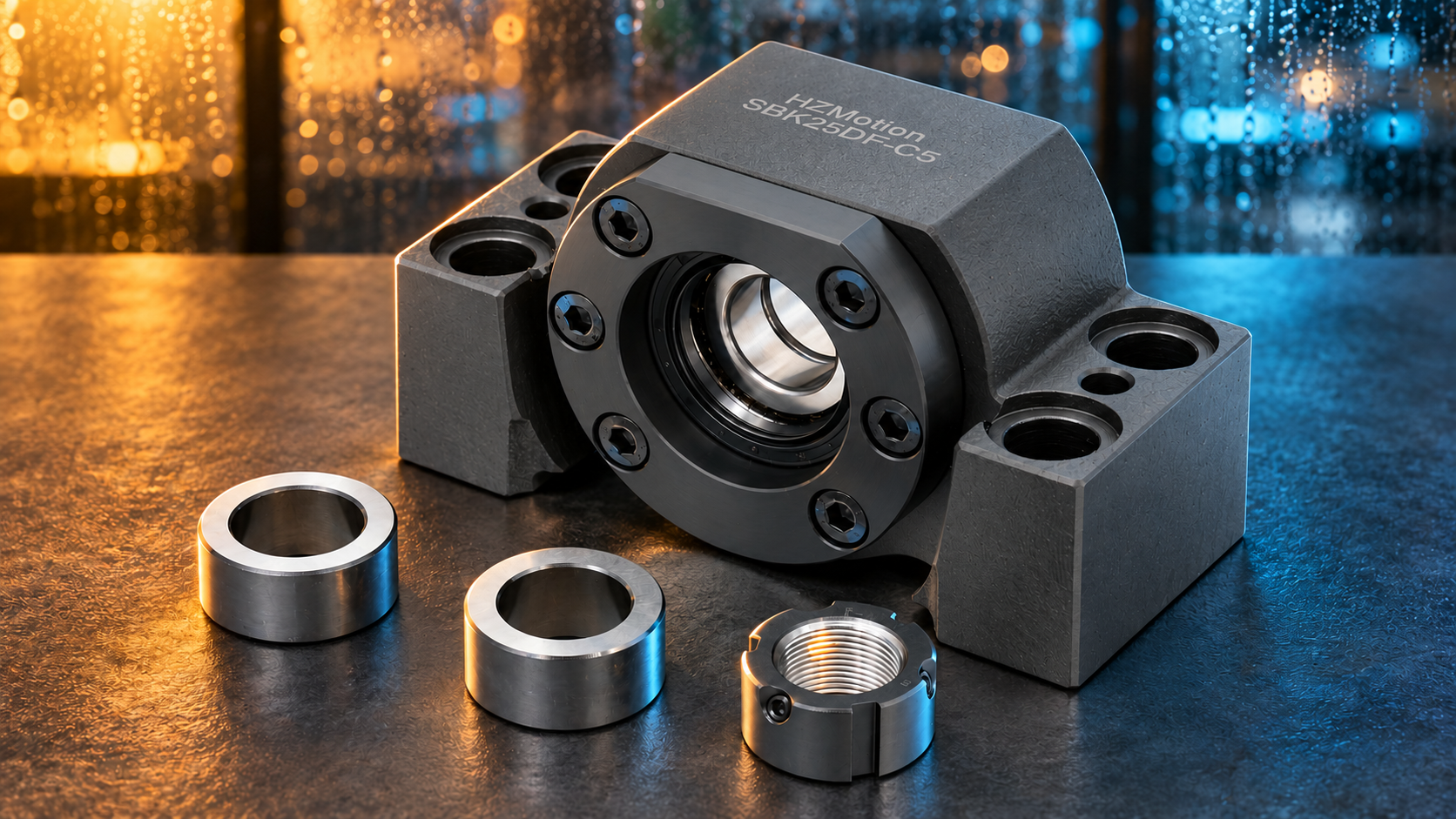
01 / Protection roles
Give each part of the problem a clear owner
A clean, rust-free exterior does not prove that a bearing is dry inside. A well-sealed bearing can also sit in a housing whose mounting feet remain wet. Separating these conditions makes it easier to specify surface protection, sealing and maintenance.
Protect exposed metal
Consider steel surfaces, threads, scratches and contact crevices. Surface treatment and routine protection both matter.
Limit contaminant entry
Review rotating-shaft interfaces, joints and connections. Check actual seals and fluid compatibility rather than judging by surface colour.
Reduce direct exposure
Use layout, splash management, drainage and cleaning procedures to limit the water, chips and cleaning fluid reaching the components.
A coating does not replace a bearing seal; a seal does not replace splash management; a cover does not remove the need for inspection. If an IP rating is required, identify the complete assembly and the conditions to be verified.
02 / Exposure record
Turn a damp workshop into usable design inputs
An occasional splash and a washdown every shift are different duties, even when the machines stand next to each other. Record where the liquid comes from, how long it stays and how it leaves.
| Condition | Record | Design and maintenance focus |
|---|---|---|
| Humidity and temperature changes | Temperature/humidity range; condensation during shutdown or after doors open. | Cold surfaces, mounting feet and crevices; drying and storage. |
| Coolant or process liquid | Name, concentration, temperature, supplier data and splash direction/duration. | Compatibility with finishes, seals and lubricant; shielding, drainage and cleaning access. |
| Dust and chips | Dry dust or wet chips; particle character and accumulation points. | Debris removal, interface protection and access; avoid trapped wet chips. |
| Cleaning | Wiping or spraying; medium, pressure, temperature, distance and frequency. | Prevent direct entry at rotating interfaces; review with the machine cleaning procedure. |
| Transport and idle storage | Packaging, duration, humidity changes and restart arrangements. | Packaging condition, corrosion protection and inspection after storage. |
Photographs of the same location during operation, after cleaning and the next morning can help distinguish direct splash, trapped liquid and condensation. They are more useful than an early guess about which finish has failed.
03 / Finish and fit
Specify the finish together with the final fit
The special-surface-treatment section of the HZMotion ball screw support-unit manual lists black oxide for standard steel housings, with black chromium plating, decorative chromium plating and nickel plating available for enquiry. This statement concerns the support-unit range. Available treatments for motor brackets, nut brackets and other materials must be confirmed for the actual part.
| Check | Question to resolve | Specification approach |
|---|---|---|
| Material and treated area | Steel, aluminium or another material; which surfaces need treatment? | Identify part number and drawing revision. Do not assign one finish indiscriminately. |
| Exposure | Is the treatment compatible with process and cleaning liquids? | Provide chemical data, concentration and temperature; agree the verification method. |
| Dimensions and roughness | What must the bore, pilot and thread achieve after treatment? | Specify final acceptance dimensions, masking or post-treatment machining where needed. |
| Assembly and service | Where are contact surfaces, tool-contact areas and liquid traps? | Retain correct seating, cleanability and access for protection. |
| Acceptance evidence | Which visual, thickness, adhesion or corrosion checks are applicable? | Agree test conditions and criteria. Test hours are not a direct conversion to field life. |
A 5 micrometre thickness example
For a uniform metal coating added to the surface, a radial thickness t increases an outside diameter by about 2t and reduces a bore diameter by about 2t.
dafter ≈ dbefore + 2t
Dafter ≈ Dbefore − 2t
If t = 5 micrometres = 0.005 mm, the diameter change is approximately 0.010 mm. If both bore and mating shaft are plated, diametral clearance falls by approximately 2(tbore + tshaft). The 5 micrometre value is an illustrative input, not an HZMotion finish specification. This added-layer model must not be applied directly to conversion treatments such as black oxide.
Define final dimensions and function at precision pilots, bearing bores, locating faces and locking threads before treatment. If an assembly interferes, review dimensions and process records before choosing a repair; avoid unplanned grinding of critical surfaces.
04 / Workshop routine
Give liquid an exit and inspections a record
- Before operation: review entry pathsCheck splash protection, drainage and access. Inspect surfaces and visible seals after unpacking. Confirm that specified cleaning or protective agents are compatible with seals and lubricant.
- After cleaning: review what remainsUnder the machine safety procedure, inspect mounting feet, hole edges, joints and sheltered areas. Remove residual liquid and debris, then restore specified protection.
- After storage: compare with the baselineRecord idle duration and conditions. Before restart, check surfaces, running resistance, noise and temperature behaviour. Keep photographs and operating records when conditions change.
Protecting exposed stationary surfaces is different from replenishing grease inside a bearing. The HZMotion support-unit manual identifies factory lubrication and advises against dismantling fixed-end assemblies. Do not open a preloaded bearing set merely to address an external rust mark. See fixed-end support-unit disassembly and repair assessment.
05 / Enquiry checklist
Make the first technical conversation useful
Start with these five groups of information. Mark missing information as awaiting confirmation rather than replacing it with an unverified corrosion-resistance grade.
| Input | What to provide |
|---|---|
| Products and drawings | Support-unit, motor-bracket and nut-bracket models, materials, quantities and drawing revisions. |
| Medium and exposure | Liquid name, concentration, temperature, contact mode, duration and cleaning conditions. |
| Critical interfaces | Bores, pilots, mounting datums, threads and the accuracy to retain. |
| Machine provisions | Splash control, drainage, seals, ventilation, service access and photographs. |
| Acceptance and maintenance | Proposed finish, protected or masked areas, verification method, inspection responsibility and storage requirements. |
Start with the actual support unit, motor bracket and nut bracket. Put environmental conditions and interface dimensions in the same enquiry.
06 / Questions
Corrosion-protection questions
Can black oxide, nickel plating and chromium plating be ranked universally?
A process name alone is insufficient. Material, preparation, treatment quality, surface integrity, medium and exposure all matter. Compare under defined conditions.
Does a corrosion-resistant housing permit direct washdown?
Rotating interfaces, seals, connections and the machine cleaning procedure still need assessment. A housing finish does not automatically give the complete assembly an IP rating.
Can brackets use the same treatment as a support unit?
Confirm the actual model, material and critical fits. Options listed for support units are not automatically standard configurations for every bracket.
Does a rust mark mean the complete assembly must be replaced?
Assess location, depth and effects on fit, sealing and operation. Damage at critical fits, rolling contacts or seal contact surfaces needs technical assessment; appearance alone is not enough.