Published:2026-09-15 00:32:11
Standard vs integrated motor brackets
Choose the structure, then verify performance
Integration can reduce connecting interfaces. Standard brackets allow combinations with separate support units. Compare assembly accuracy, parts, stiffness, complete cost and service needs against the same machine requirements.
01 / Define the structure
Start with whether the bearing support is separate or integrated
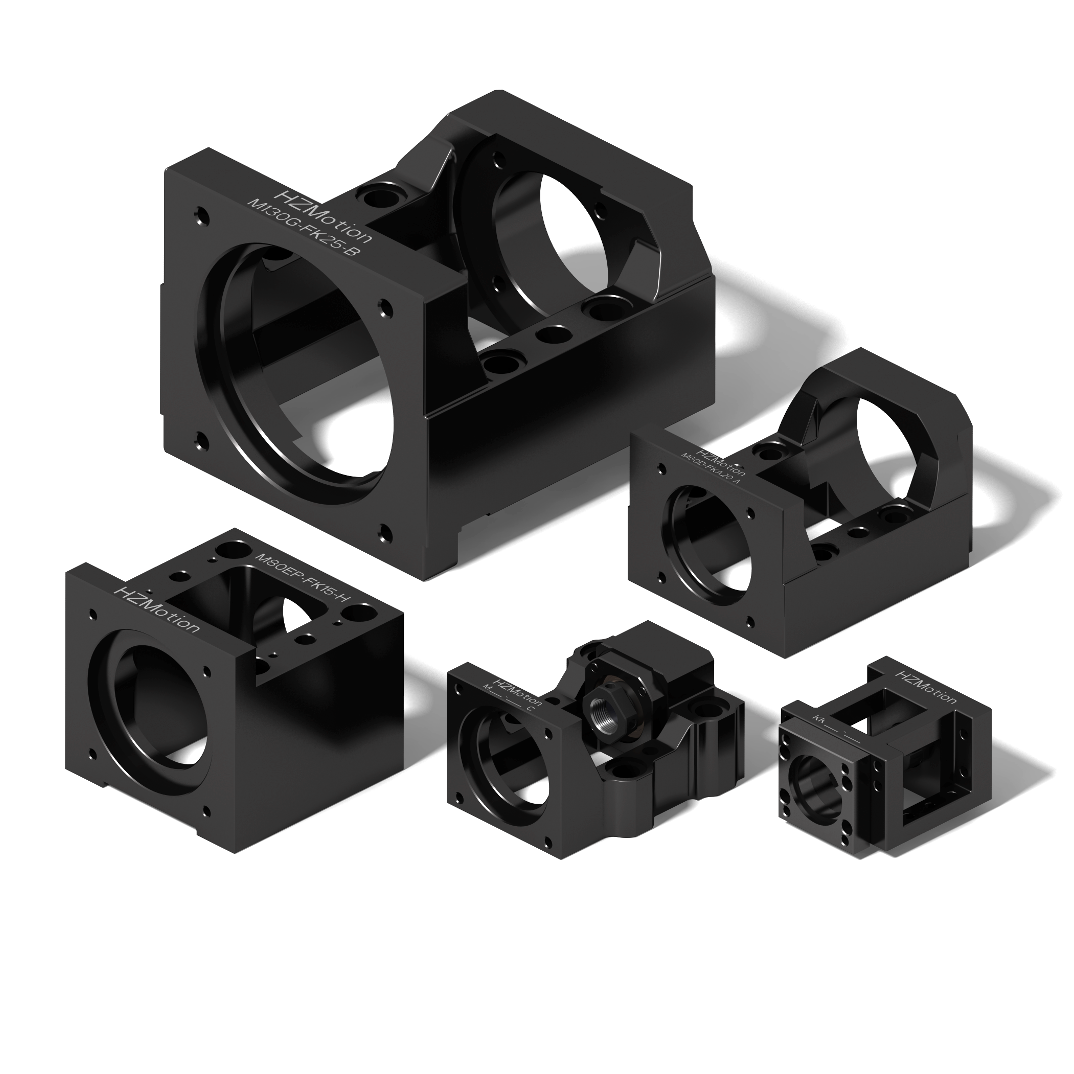
HZMotion offers standard motor brackets used with separate ball screw support units, and integrated brackets with the support bearings inside the bracket housing. Both connect the motor, coupling, screw and machine base. The difference is how the motor locating datum relates to the support bearings.
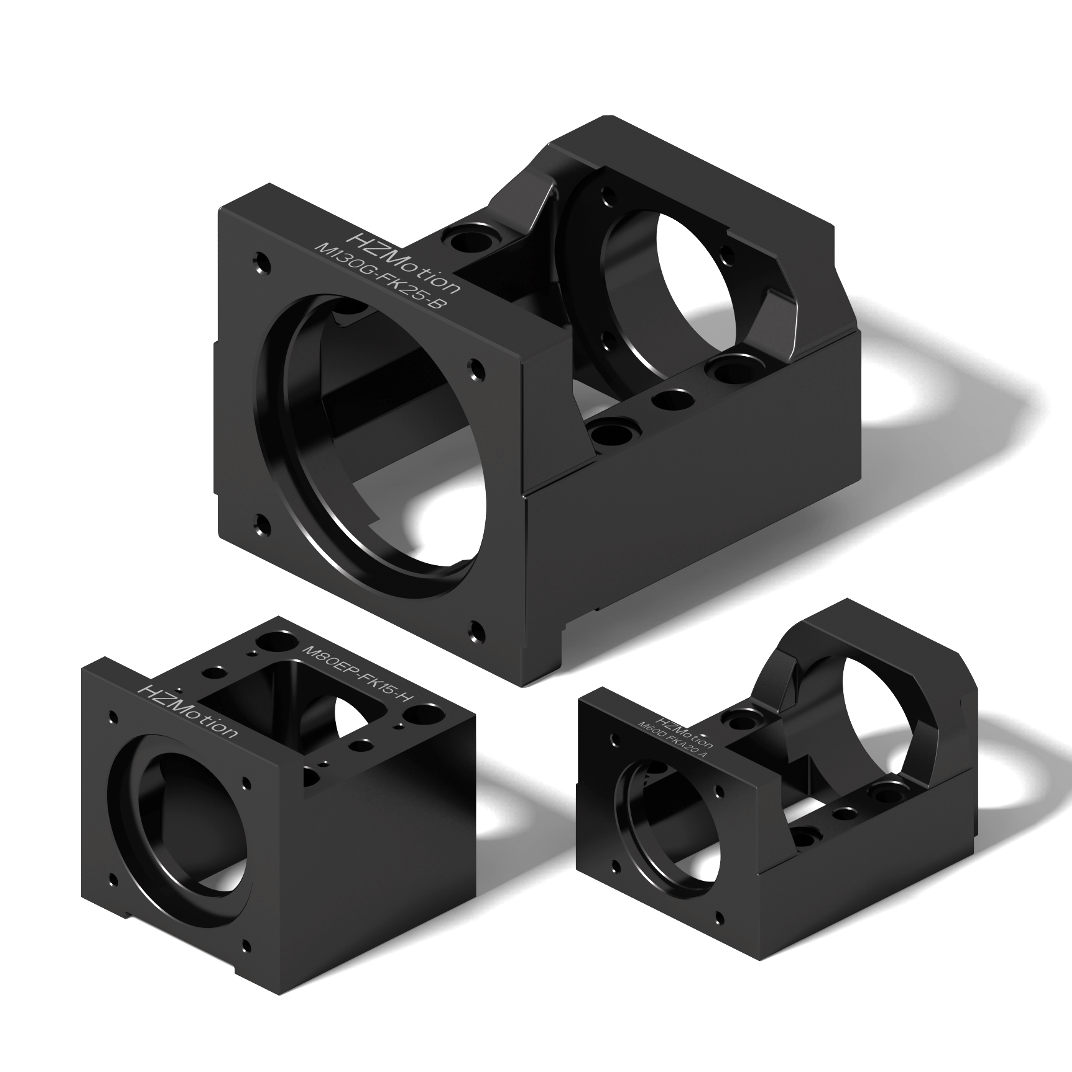
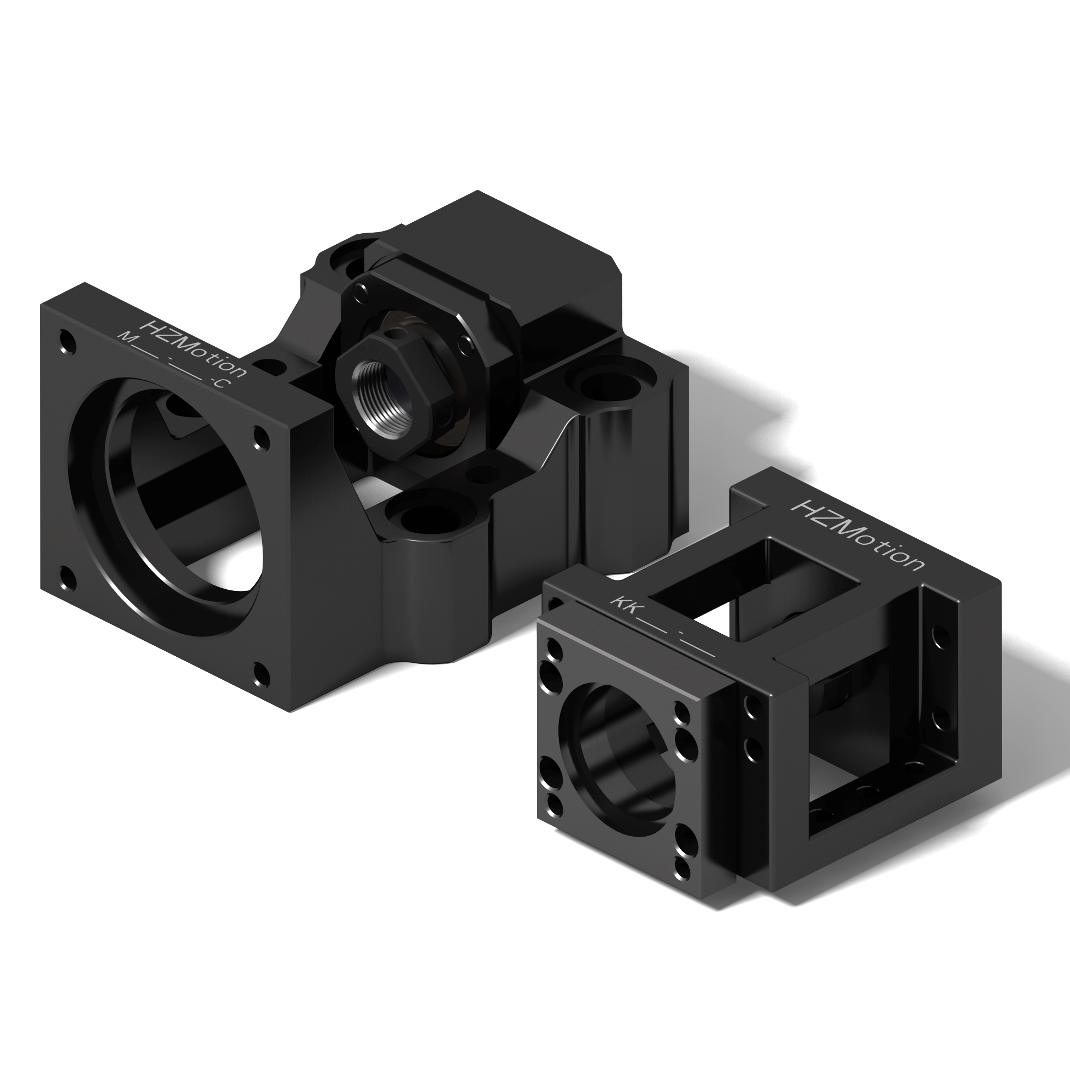
Standard does not mean the bracket must be assembled from separate plates: the housing itself can be manufactured as one body. Integrated does not mean the complete assembly contains only one part. Bearings, covers, seals, collars and locking parts may still be required, depending on the configuration.
This comparison concerns integration of the motor bracket and ball screw fixed-end support. It does not refer to integration of the servo drive, motor and controller. Identify the actual assembly before comparing product names.
02 / Six comparisons
Fewer interfaces can help, but assess each machine requirement separately
| Criterion | Standard bracket + separate support | Integrated bracket | What to compare |
|---|---|---|---|
| Assembly accuracy | An additional support locating and fastening relationship must be controlled during assembly. | More of the motor-pilot-to-bearing-bore relationship is controlled within one housing. | Machining datums, fits, final shaft alignment and repeatability after reassembly. |
| Parts and interfaces | The matching support unit and its connecting parts are purchased and assembled separately. | Can remove a separate housing and joint, although an adapter flange or other accessories may remain. | Use the same supply scope; distinguish total part count from interfaces that require alignment. |
| Stiffness | Depends on the bracket, support unit, joints and machine base. | Removes some joint compliance, but housing section, overhang and bearing configuration still matter. | Deflection or stiffness at the same load, direction, load position and mounting conditions. |
| Purchase and assembly cost | Separate components can be sourced individually; include joint machining and alignment labour. | Assembly purchasing is more consolidated and some installation work may be reduced. | Complete purchasing, machining, assembly, inspection and spare-parts costs. |
| Serviceability | The support or bracket may be replaced separately, followed by acceptance checks. | A complete assembly can be replaced; internal repair needs a defined procedure and verification. | Fault location, spare availability, access and time to restore the required accuracy. |
| Design changes | Some components may be retained when the motor or support changes, if interfaces remain compatible. | Standard combinations can simplify repeat designs; larger changes may require a new or custom housing. | Motor pilot, threads, shaft extension, bearing arrangement and machine mounting envelope. |
The integrated label alone does not establish higher accuracy, capacity or lower cost. Nor does a standard bracket automatically mean difficult installation. Evaluate the selected configuration, datum design, manufacturing quality and site conditions.
03 / Assembly accuracy
Shared machining datums shorten part of the locating chain
With a standard bracket, the locating chain includes the motor pilot, bracket locating bore, separate support interface, bearing bore and screw journal. Integration brings some of those relationships into one housing. It does not remove motor-shaft error relative to the motor pilot, bearing fits, screw journal error or machine-base mounting error.


Centre height, locating bore size, face perpendicularity and assembled shaft alignment are different characteristics. Passing one drawing dimension does not establish acceptable offset and angular alignment at the coupling. The illustrated dimensions apply to the relevant series and sizes, not every motor bracket.
An interface record should include pilot diameter and depth, bolt circle, hole threads, shaft diameters and extensions, centre height and coupling space. See the servo motor bracket interface guide for selection checks and the shaft misalignment guide for checks after assembly.
04 / Stiffness and load
Locate the main source of deflection before choosing integration
Assess load-bearing sections, overhang, contact surfaces, bolt layout and specified bolt preload. A stiff housing on a flexible base can still move significantly.
Identify bearing type, matched arrangement, preload and allowable loads. Similar external dimensions or the same bore do not establish equivalent bearing performance.
Include coupling torsional stiffness, screw extension and bending, the nut and guide connections. A stiffer bracket may have little effect if another component dominates the error.
Compare deflection with the same load, direction, load position, mounting conditions and measurement point. Axial stiffness, radial stiffness, resistance to tilting and allowable load answer different questions; a single description such as more rigid cannot replace them.
Integration may help when a separate support joint contributes significant movement. If the dominant source is overhang, a flexible base plate or the coupling, address that component first. This is an engineering assessment of the load path; quantify the benefit through calculation or measurement.
Do not raise the machine load or speed solely because a bracket is integrated. The selected assembly must also satisfy bearing life, static safety, screw critical-speed and machine operating requirements.
05 / Cost and service
Include installation, downtime and the work needed to restore accuracy
| Item | Information required | A fair comparison |
|---|---|---|
| Complete purchase | Bracket, support unit or internal bearings, locking parts, adapters, coupling and accessories. | Quote equivalent accuracy, bearing configuration and supply scope; do not compare an empty housing with a complete assembly. |
| Machining and assembly | Base machining, tooling, interface alignment, final tightening and inspection labour. | Record actual steps and labour time rather than assuming that integration eliminates alignment. |
| Spares and downtime | Smallest available replacement unit, lead time, on-site replacement and commissioning time. | Compare both the spare cost and total time to restore the machine. |
| Future modifications | Expected changes to motors, screw ends, bearing grades and available space. | Identify retained parts, interfaces requiring machining and the cost of requalification. |
A production line that needs rapid recovery may benefit from a spare complete assembly with a verified configuration. Equipment that changes frequently or requires component-level service may benefit from a separate support unit. Both depend on actual supply and service capability; neither justifies a fixed cost or downtime saving claim.
Internal bearing service must restore the specified arrangement, preload, lubrication and sealing. A complete housing replacement still requires inspection of the screw journal and external alignment. See the fixed-end support repair guide for the service boundaries.
06 / Application choices
Choose around machine constraints and recheck axial dimensions when replacing
| Machine condition | An option to assess first | Decisive checks |
|---|---|---|
| Existing fixed-end support, screw and base are to be retained | A standard bracket compatible with the existing support. | Support model, locating interface, centre height, mounting holes and coupling space. |
| New design seeking fewer separate fixed-end joints | A suitable integrated C- or KK-series configuration. | Motor and screw interfaces, internal bearings, mounting orientation and service access. |
| Several motor models must be accommodated | A standard combination or an integrated option with suitable adapter flanges. | Additional axial length, locating fits and tool interference introduced by an adapter. |
| High dynamics, heavy loading or demanding positioning | Compare specific assemblies using the machine calculations. | Deflection under equivalent conditions, bearing configuration, thermal behaviour, alignment and commissioning results. |
For example, replacing a standard bracket and separate fixed-end support with an integrated bracket can change the distance from the motor mounting face to the bearing locating face, even if the motor pilot and bolt holes match. That changes the relationship between the shaft ends and may affect coupling grip length or the shaft-end gap. External appearance and overall length alone cannot establish interchangeability.
This is a replacement-check example, not a claim that two particular models are interchangeable. A/B/H/L and C/KK have specific configurations; a support designation in the part number does not replace the complete drawing.
07 / Selection workflow
Compare with one data set and accept the installed result
- Define the application Record load, speed, travel, acceleration, orientation, space and service needs. State whether this is a new design or an existing-machine replacement.
- Provide both interfaces Supply the complete motor model and drawing, screw-end drawing, base drawing and coupling specification. Identify parts that must be retained.
- Confirm the configuration List the separate support for a standard bracket, or the internal bearings and accessories for an integrated unit. Check accuracy, arrangement, preload and supply scope.
- Compare performance and cost Use common conditions to assess stiffness and load capacity, and include purchase, machining, assembly, inspection and spare costs.
- Define inspection criteria Record each limit and its source, instruments and measurement points. Include alignment before and after tightening, full-travel checks and cold/warm running records.
- Retain first-article results Record assembly time, adjustments, final geometry and running trends to support repeat production and future service.
When sending motor and screw drawings to HZMotion, include the installation envelope, parts to be retained and preferred service method. This gives a clearer selection basis than motor power alone.
08 / FAQ
Frequently asked questions
Does an integrated bracket remove the need for alignment checks?
No. It reduces some locating interfaces, but motor, shaft, bearing-fit, coupling and mounting-surface errors still affect the assembled shaft system.
Is a standard bracket always less stiff?
No. Compare the housing, joints, base and bearing configuration under the same conditions, then calculate or measure the dominant deflection.
Does a higher integrated-unit quote mean a higher total cost?
Not necessarily. Compare the same supply scope and include assembly, inspection, spares and downtime. Integration is not automatically cheaper either.
Are motor power and flange width enough to select a bracket?
No. Check the pilot, bolt circle, threads, extensions, screw end, centre height, bearing configuration, coupling and mounting space.
Can the two structures be interchanged if the motor interfaces match?
Not necessarily. Verify axial locating distances, both shaft extensions, effective grip lengths, shaft-end gap, base holes and bearing support configuration.