Published:2026-10-19 12:00:00
Updated:
Linear actuators · Lubrication and care
Make each service useful to the next decision
The most useful handover can be simple: which axis, how much travel, what lubricant went where, and whether running behaviour changed. Recording those facts turns maintenance into work that another person can continue and verify.
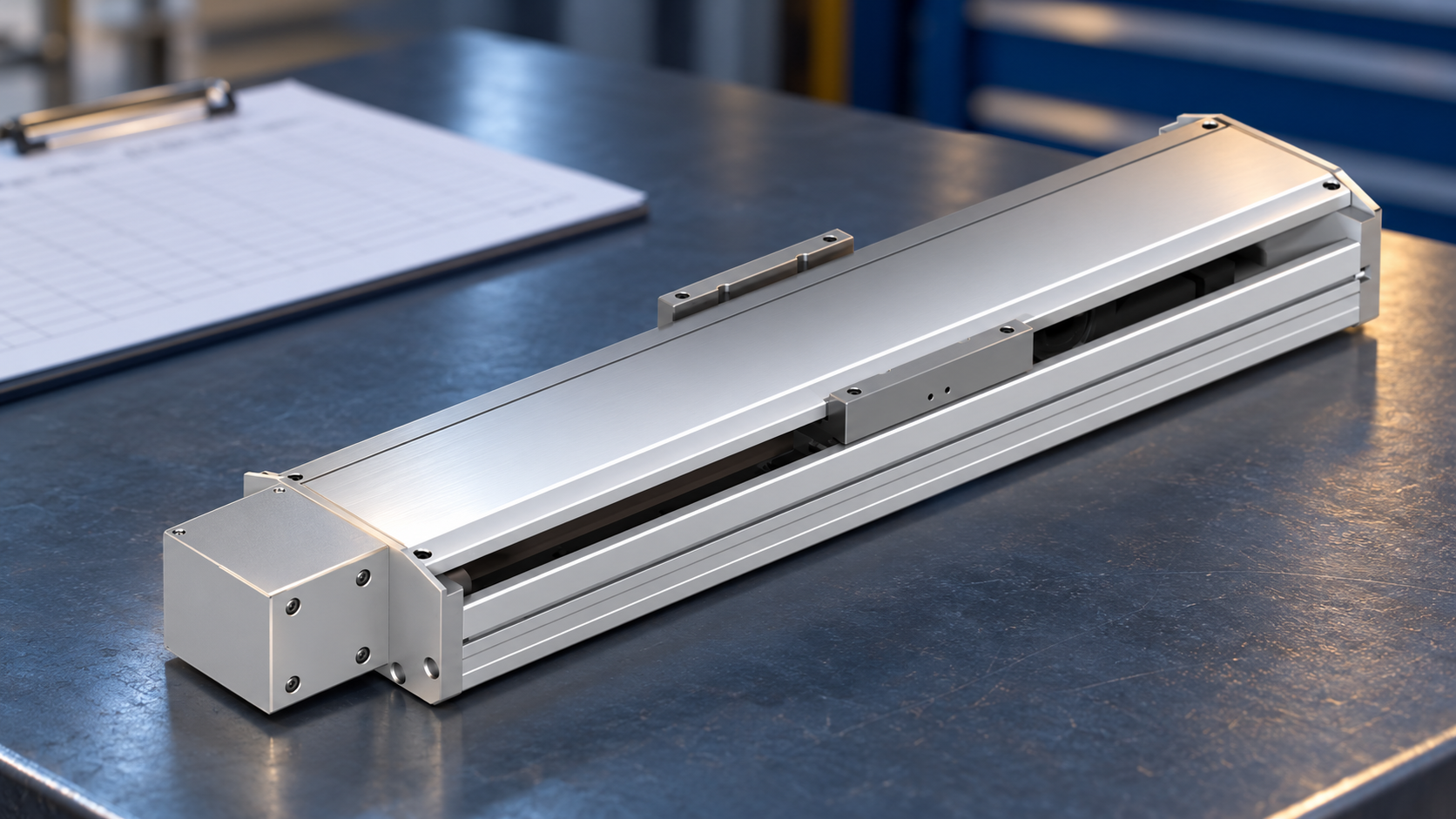
01 / Component boundaries
One axis contains several different lubrication tasks
Identify the construction before servicing it. A screw drive, linear guides and support bearings have different duties. A belt-driven axis has no ball screw, but its guides may still need lubrication. One grease gun does not replace this component map.
| Component | Purpose | Maintenance boundary |
|---|---|---|
| Ball screw and nut | Maintain lubrication at rolling contacts and control contamination. | Use specified grease points, lubricant and quantity. An external smear does not prove that all internal raceways are supplied. |
| Linear guides and blocks | Maintain the guiding contacts. | Identify each block and supply path. Grease at one location does not prove delivery to all blocks. |
| Fixed-end and support-end bearings | Support the rotating shaft; some assemblies are sealed or factory-lubricated. | Check assembly-specific instructions. Do not dismantle a preloaded fixed-end set for routine greasing. |
| Timing belt and pulleys | Transmit motion; inspect cleanliness and condition as specified. | Do not assume grease belongs on the belt or teeth. Treat guide lubrication separately. |
| Exposed stationary surfaces | Corrosion protection and cleaning. | Follow surface-care requirements. A rust preventive is not automatically the correct motion lubricant. |
Locate lubrication points from the model drawing or instructions, not appearance. Do not mistake a fastening hole for a grease port. Oil-storage blocks, automatic lubrication and other special configurations need their own maintenance requirements.
02 / Manual baseline
Turn general guidance into a model-specific maintenance card
Section 9 of the HZMotion linear-actuator manual provides lubrication and maintenance guidance. Use it as a starting reference, then confirm the delivered model, lubrication configuration and operating conditions.
| Manual item | General guidance | Application on site |
|---|---|---|
| Ball screws and linear guides | Lists lithium-based No. 2 grease; recommends checking for chips, dust and dirt every 100 km, cleaning and replenishing grease. | Confirm the exact factory lubricant, compatibility, points and quantity. Use the interval only within the applicable conditions. |
| Periodic grease replacement | Includes an annual replacement arrangement and earlier action where contamination requires it. | Confirm the method and shutdown procedure for the model. Do not wait for a calendar date when abnormal contamination occurs. |
| Support bearings | Under general conditions, long use without replenishment is described; lubrication-condition inspection is suggested at 1,000 km, with action if needed. | Inspection does not authorise dismantling. Confirm inspection, replenishment or replacement procedures for the assembly. |
The separate HZMotion support-unit manual states that units are factory-greased, do not need additional grease before use, and must not have the fixed-end assembly dismantled. Together these instructions make one point clear: identify the component before assigning a maintenance action.
General guidance cannot cover every special lubricant, load, temperature, clean environment or contamination condition. Record model and instruction revision; delivered or specifically approved requirements take precedence. NLGI 2 is a consistency grade, not a unique formulation or proof that two greases can be mixed.
03 / Travel calculation
The same 100 km can arrive on very different dates
A calendar week means something different to an axis that reciprocates continuously and one that moves only occasionally. Converting operating time into accumulated travel gives maintenance a comparable basis.
Lday = 2 × s × n × 60 × h / 1,000
s: one-way travel in m; n: complete return cycles per minute; h: hours/day at that rate. Result: km/day.The factor 2 includes outbound and return travel. Do not multiply by 2 again if a counter already counts individual legs. Sum different distances and duty periods separately. Accumulate absolute travel, not the near-zero net displacement after a return cycle.
| Assumed duty | One way s | Return cycles n | Runtime h | Daily travel |
|---|---|---|---|---|
| Longer stroke | 0.50 m | 40/min | 8 h/day | 19.20 km/day |
| Shorter stroke | 0.05 m | 40/min | 8 h/day | 1.92 km/day |

Travel alone reaches 100 km after approximately 5.21 operating days in the longer-stroke case and 52.08 operating days in the shorter one. The longer-stroke case is already at 96 km after day 5: plan the check before reaching the threshold during the next operating day. The shorter-stroke calculation does not authorise 52 days without inspection.
Short strokes may repeatedly work a local raceway region, while contamination and storage conditions do not disappear when mileage is low. These assumed cycle rates illustrate counting only; they do not establish any actuator model's motion capability.
04 / Inspection triggers
Watch travel, calendar time and condition together
Use the approved interval
Track travel or operating hours since the previous service against the requirement for the actual model.
Include storage and ageing
Respect the specified calendar limit. Inspect before restarting after extended storage, even with little travel.
Respond to changes
Investigate contamination, seal damage, temperature, noise or running-resistance changes without waiting for the nominal interval.
First confirm that the duty is within the model's permitted operating conditions. HZMotion general instructions require suitable special protection for environments involving heavy dust, water, oil or corrosive media. More frequent greasing does not extend the permitted environment of a standard actuator.
Once suitability is confirmed, short strokes, high frequency, persistent vibration or unusual temperatures need focused observation during initial operation. If a longer distribution stroke is proposed, have its range, frequency and machine interlocks confirmed. Do not apply an arbitrary full-stroke routine to every machine.
| Observation | Check first | Then decide |
|---|---|---|
| Dry point or uneven supply | Ports, lines, distributors and service records. | Verify delivery to the specified location before choosing an action. |
| Contaminated grease, wet chips or liquid | Entry paths, guarding, cleaning and seals. | Control the source, then use the approved cleaning or maintenance procedure. |
| Changed resistance after greasing | Quantity, lubricant, temperature and distribution. | Recheck under the prescribed running-in procedure. Investigate persistent anomalies rather than adding more blindly. |
| Temperature, noise or positioning changes | Comparable baseline conditions, assembly, load and fastening. | Consider lubrication as one possible cause, not a diagnosis made from a symptom alone. |
Combine this record with corrosion protection and environmental suitability. A useful plan says when to inspect another cause as well as when to lubricate.
05 / Service procedure
Leave a comparison that can be checked later
- Identify the component and suppliesConfirm the model, location, approved grease, quantity, tools and cleaning method. Replacement products need compatibility and conversion procedures; do not mix greases on assumption.
- Stop and clean under the procedureApply the prescribed shutdown, isolation and unintended-motion controls. Remove external contamination and keep the tool and interface clean.
- Use the specified path and quantityFor serviceable locations, follow the approved delivery path and dose. Record mass or volume; if counting grease-gun strokes, confirm delivery per stroke first.
- Run under controlled conditions and recheckUse the approved distribution or running-in procedure. Stop again under the safety procedure before personnel approach. Compare resistance, temperature behaviour and noise under equivalent conditions.
- Record the result and next triggerRecord lubricant, quantity, accumulated travel, findings and actions. Set the next planned check plus conditions that require earlier inspection.
Large amounts of escaping grease are not a universal filling criterion. Support-bearing assemblies, special seals and central systems have their own procedures. Do not change preload or dismantle precision rolling components during routine service.
06 / Maintenance record
Make the next shift able to use the record
A note that simply says serviced offers little help next time. These fields retain the component, quantity and outcome and can form a practical maintenance card.
| Field | What to enter |
|---|---|
| Machine, axis and model | Machine/axis ID, actuator model, serial number and instruction revision. |
| Exact component | Screw, numbered guide block, support assembly or another clearly identified point. |
| Duty | Stroke, return-cycle rate, actual operating time, load, temperature and contamination. |
| Travel and date | Total travel, travel since previous service, date and operating hours. |
| Lubricant and dose | Full designation, batch, actual mass or volume, tool and delivery location. |
| Before and after | Contamination and seal condition; comparable resistance, noise, temperature behaviour and anomalies. |
| Decision and ownership | Action/result, operator, reviewer, next distance/date and early-inspection triggers. |
For an initial plan, provide the model, current lubricant and complete duty cycle. This is more useful than asking for one universal greasing frequency. Revise the plan from recorded observations and retain the reason for each change.
07 / Questions
Lubrication-planning questions
Can every linear actuator be greased every three months?
No universal period applies. Combine the actual model, travel, factory lubrication, environment and delivered instructions. Manage travel, calendar and condition triggers together.
Can two lithium-based No. 2 greases be mixed?
That description is not enough. Base oil, thickener system, additives and actual product compatibility still matter. Use approved products and a confirmed changeover procedure.
Does a belt-driven actuator need no lubrication?
Do not assume grease belongs on the belt, but guide components may still need it. Review each component rather than deciding from drive type alone.
Does a 100 km inspection point specify a fixed grease quantity?
Inspection interval and dose are separate parameters. Check condition and follow the model-specific procedure; distance cannot be converted into a universal number of grease-gun strokes.
Can the fixed-end support be opened for routine greasing?
Do not dismantle the preloaded assembly for routine replenishment. HZMotion identifies factory lubrication and prohibits fixed-end disassembly in its support-unit instructions. Confirm a technical service plan when action is required.