Published:2026-08-08 23:30:00
Ball screw support-unit selection
Define the end function first, then choose the housing and bearing configuration
A standard fixed end, a support end and a heavy-duty fixed end are not interchangeable price grades. They perform different tasks in axial location, radial support, rigidity and mounting. Select the end-support arrangement first, then verify the interface, shaft diameter, load and accuracy.
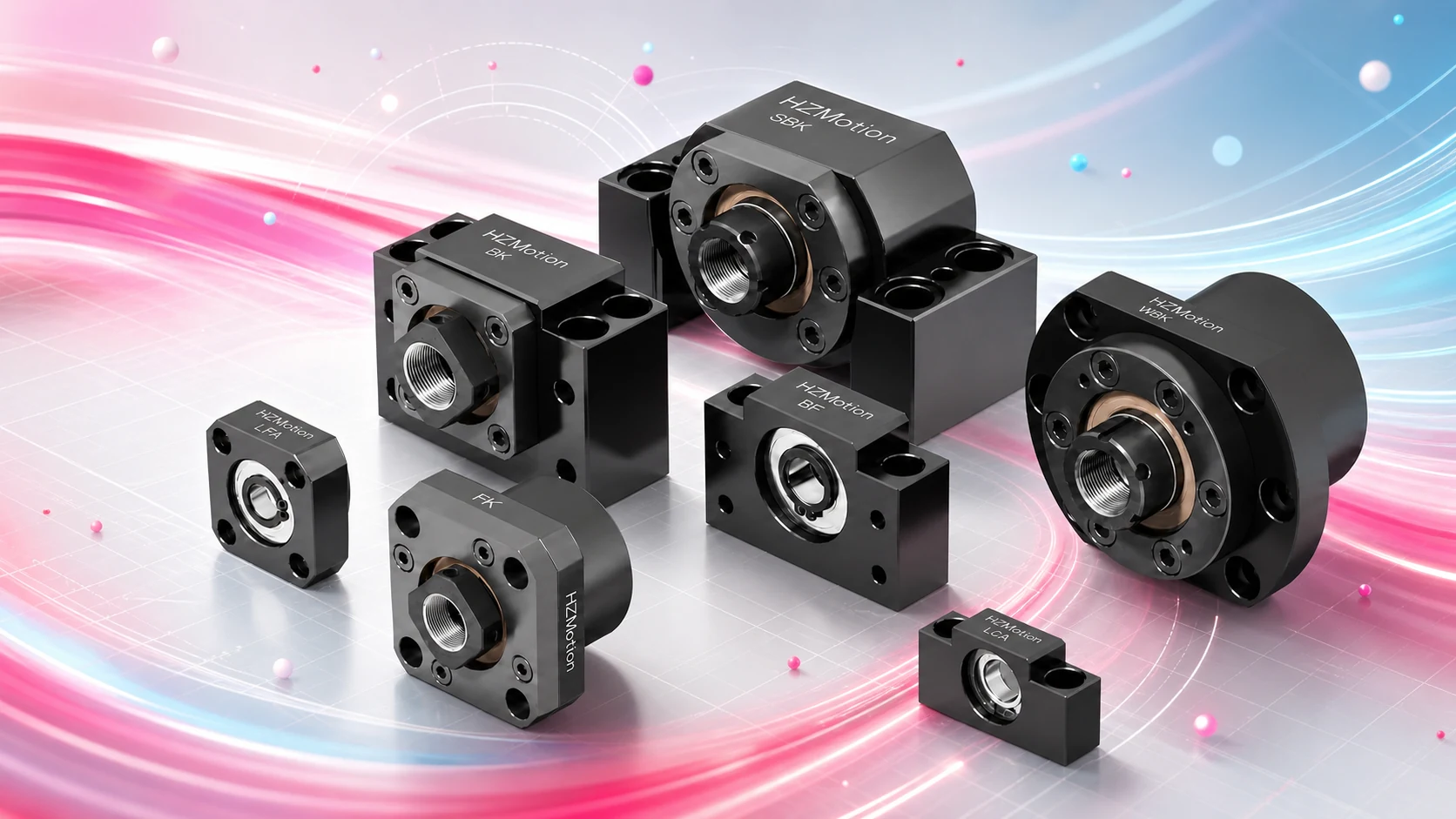
01 / Functional roles
What do fixed, support and heavy-duty fixed ends do?
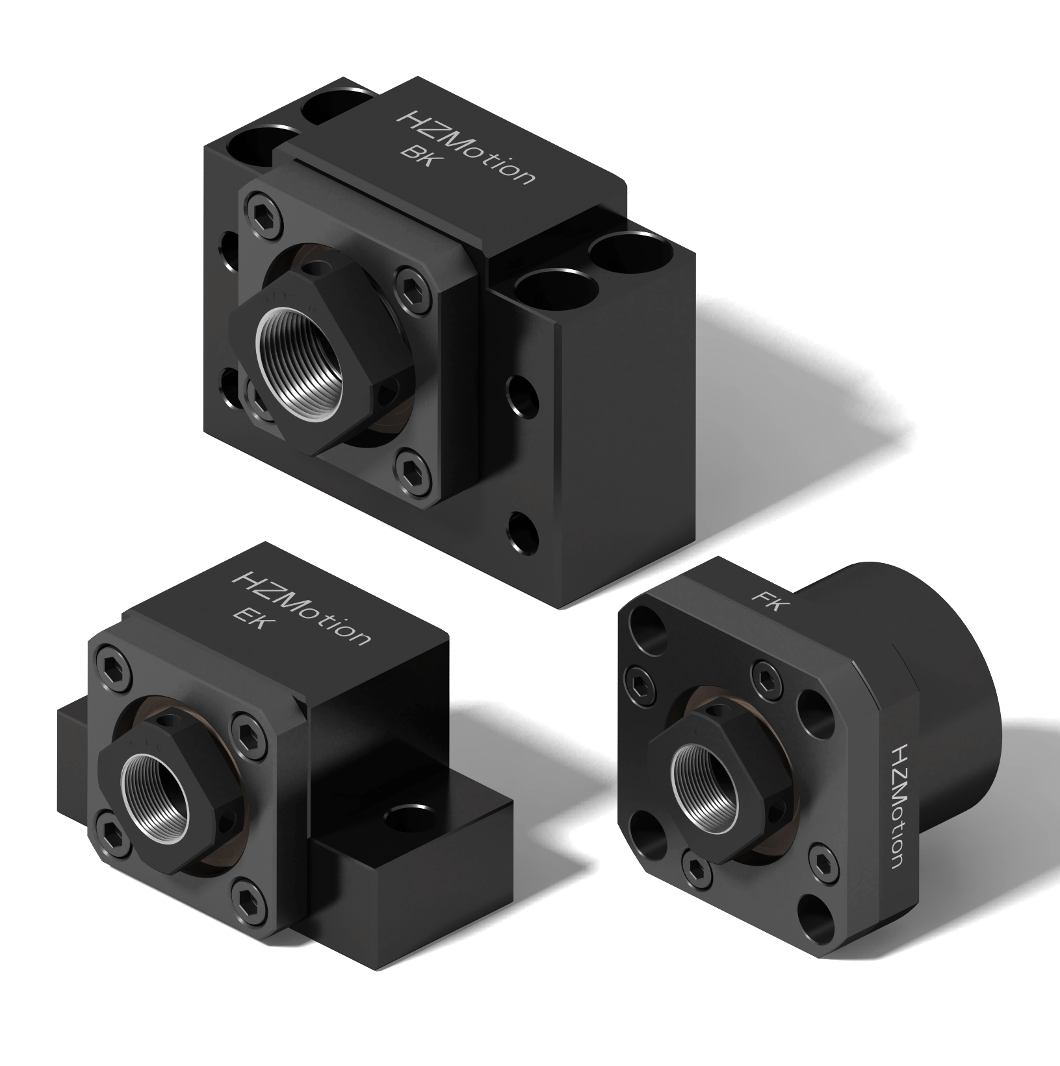
Standard fixed end
The bearing set, locknut and housing establish the ball screw's axial datum and carry operating thrust. Standard versions commonly use DF-arranged angular-contact bearings. The same housing families may also offer economical E configurations or TAC configurations with 60-degree angular-contact thrust bearings.
Typical use: automation equipment, CNC feed axes and general precision-positioning mechanisms.
View standard fixed-end series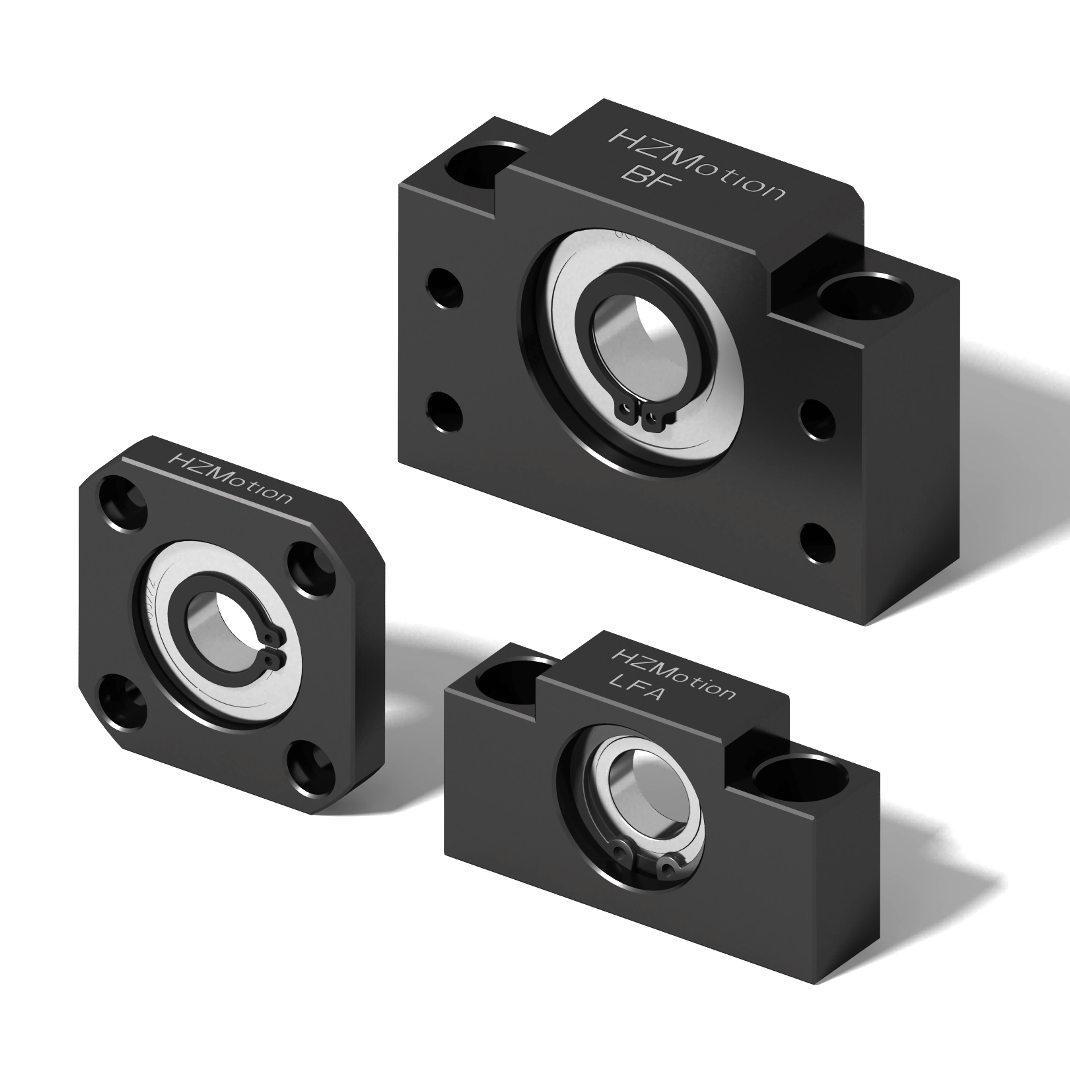
Standard support end
Mounted at the opposite end, it provides radial support and improves rotational stability. It does not establish the same axial datum or preload as the fixed end. Thermal-expansion compensation depends on the complete machine structure, fits and screw-end design and must be checked against the drawing.
Typical use: paired with a standard fixed end in a fixed-supported arrangement.
View standard support-end series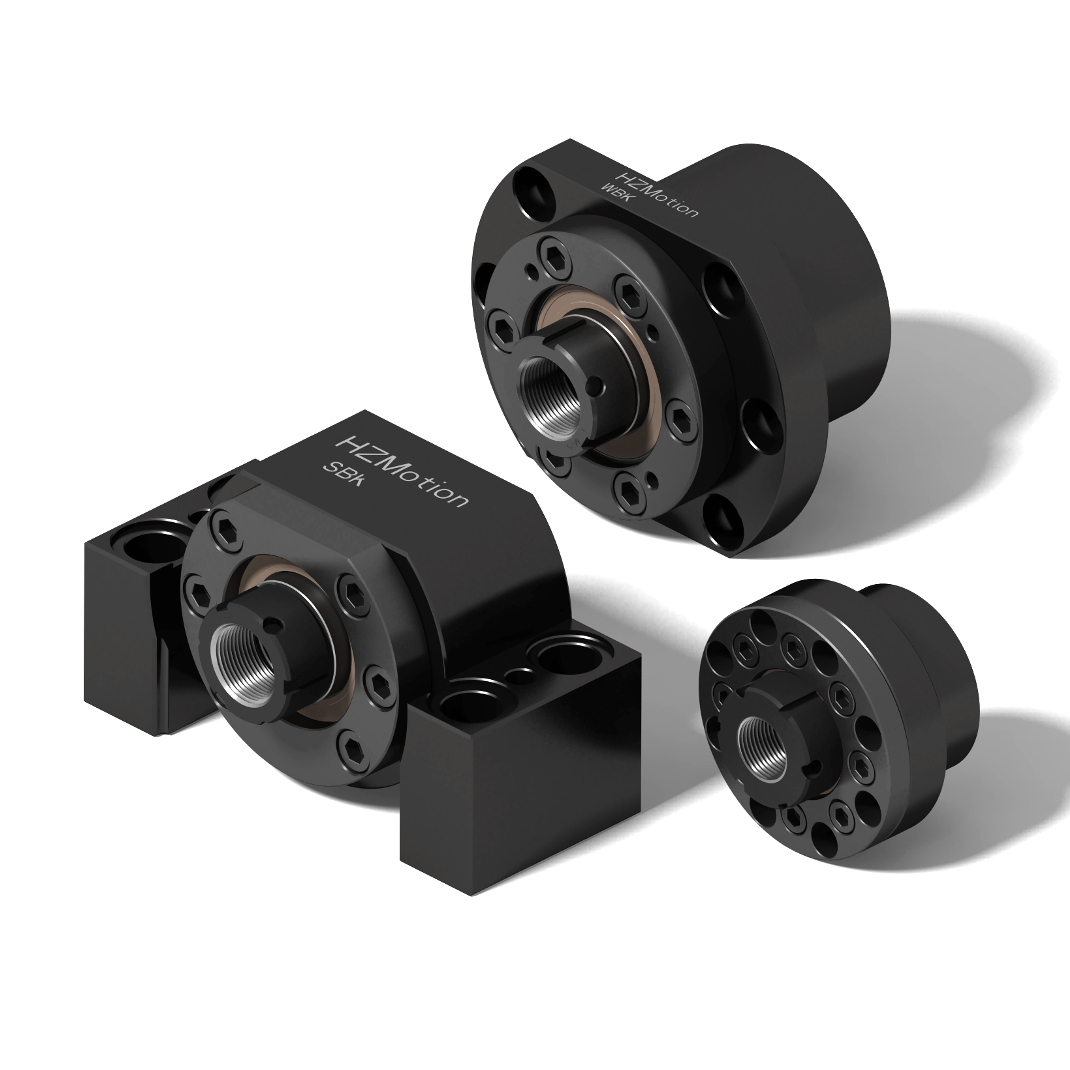
Heavy-duty fixed end
These units use 60-degree angular-contact thrust bearings and high-preload configurations, with DF, DFD, DFF, QBC and QFC arrangements available by series. Their purpose is higher axial capacity and support rigidity, not merely a larger standard housing.
Typical use: heavy-cutting machine tools, high-load feed axes and fixed-fixed pre-tensioned systems.
View heavy-duty fixed-end series02 / Support arrangement
The two ends are not selected independently
Fixed-supported
The most common arrangement for conventional equipment. The fixed end locates and carries thrust; the support end improves radial stability at the opposite end. It is straightforward to assemble and suits many medium-load, general-stroke feed mechanisms.
Fixed-fixed or pre-tensioned
Both ends provide high-rigidity support. A controlled pre-tension can improve axial rigidity and manage thermal growth. This arrangement demands better base accuracy, coaxiality, assembly control and thermal design and is commonly evaluated with heavy-duty fixed ends.
Important: fixed-fixed is not automatically better. Incorrect datums, coaxiality or pre-tension can impose extra bearing load and raise temperature. Review screw length, speed, thrust, heat generation and base accuracy together.
03 / HZMotion series pairing
Select the mounting interface first, then the bearing grade
| Fixed-end series | Matching support end | Mounting interface | Shaft diameter range | Common configurations |
|---|---|---|---|---|
| EK | EF | Mounting face parallel to screw axis | 5-25 mm | Standard, E, TAC |
| BK | BF | Mounting face parallel or perpendicular to screw axis | 10-50 mm | Standard, E, TAC |
| FK / FKA | FF | Mounting face perpendicular to screw axis | 6-30 mm | Standard, E, TAC on applicable families |
| AK | AF | Mounting face parallel to screw axis | 10-25 mm | Standard, E |
| LK | LF / LFA | Mounting face parallel to screw axis | 6-25 mm | Standard, E |
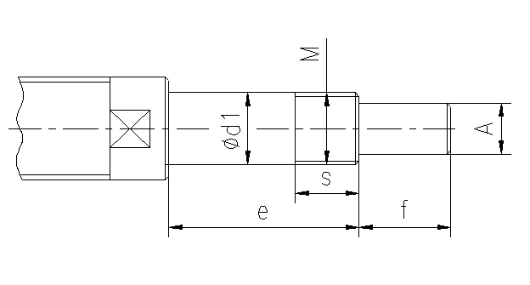
This table narrows the range using the current HZMotion product-line summary. Final selection must use the detailed drawing for d1, bolt pattern, center height, thread and shoulder dimensions.
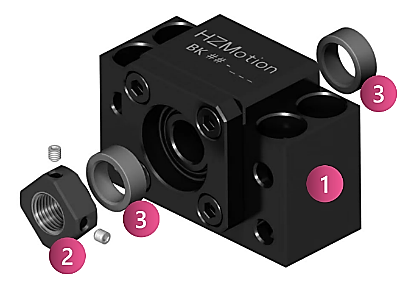
How is a standard TAC configuration different from a heavy-duty fixed end?
BK-TAC, EK-TAC and FK-TAC place 60-degree angular-contact thrust bearings in familiar standard-housing interfaces, useful when increased axial capacity is needed without changing to a dedicated heavy-duty housing. SBK, SBK-U, WBK, FBSA and MBK form a dedicated heavy-duty line with higher load ranges, more bearing arrangements and fixed-fixed applications. Compare the interface, bearing count, arrangement, preload, accuracy and available space - not just one maximum-load value.
| Heavy-duty series | Shaft diameter range | Mounting orientation | Typical considerations |
|---|---|---|---|
| SBK / SBK-U | 25-40 mm | Mounting face parallel to screw axis | High axial rigidity, DF/DFD arrangements, heavy feed axes |
| WBK | 17-40 mm | Mounting face perpendicular to screw axis | DF/DFD/DFF arrangements and fixed-fixed systems |
| FBSA | 20-60 mm | Mounting face perpendicular to screw axis | Double- and four-row arrangements for larger screws |
| MBK | 15-20 mm | Mounting face perpendicular to screw axis | Compact heavy-duty support with DF/DFF arrangements |
04 / Selection process
Six steps for preliminary selection
- Define the support arrangementChoose fixed-supported or fixed-fixed/pre-tensioned before selecting a product family.
- Check the machined screw endVerify d1, shoulder location, thread, circlip groove, effective length and tolerances.
- Check the machine mounting faceUse mounting-face orientation, center height and bolt pattern to choose EK, BK, FK, AK, LK or a heavy-duty family.
- Calculate axial loadInclude acceleration thrust, cutting force, gravity, shock, duty cycle and a suitable safety margin.
- Match accuracy and preloadUse the ball screw accuracy and positioning target to choose E, standard C5/C4, TAC5/TAC4 or heavy-duty C5/C4 configurations.
- Review speed, heat and assemblyLong or high-speed axes also require critical-speed, temperature, coaxiality, base-rigidity, lubrication and protection checks.
05 / Common mistakes
Five details frequently missed
The same screw diameter can use different end shafts, threads and spaces. Use the machined-end drawing.
It does not provide the same axial locating and preload function and is not a substitute.
Also compare arrangement, preload, accuracy, interface, speed and system rigidity.
Fixed ends are supplied with bearing preload adjusted and grease filled. Uncontrolled disassembly can disturb the preload.
Unequal mounting heights, misalignment or forced assembly can create extra load and heat even when the product is correctly selected.
06 / Quick answers
Frequently asked questions
Does every machine need one fixed end and one support end?
It is the most common arrangement, but not the only one. Short strokes, cantilever layouts and fixed-fixed systems require a separate load, speed, rigidity and thermal review.
Does a TAC type eliminate the need for a heavy-duty fixed end?
Not necessarily. TAC increases axial capacity within common housing interfaces. Heavy-duty units add dedicated structures and more bearing arrangements. Compare thrust, rigidity, space and the complete support scheme.
Must fixed- and support-end model numbers have the same size number?
Do not decide from the number alone. BK and BF are paired families, for example, but each screw-end interface still needs to be checked separately against the product drawing.