Published:2026-08-11 20:30:00
Ball screw thermal growth
A 1 m steel screw can grow about 0.12 mm after only a 10°C rise
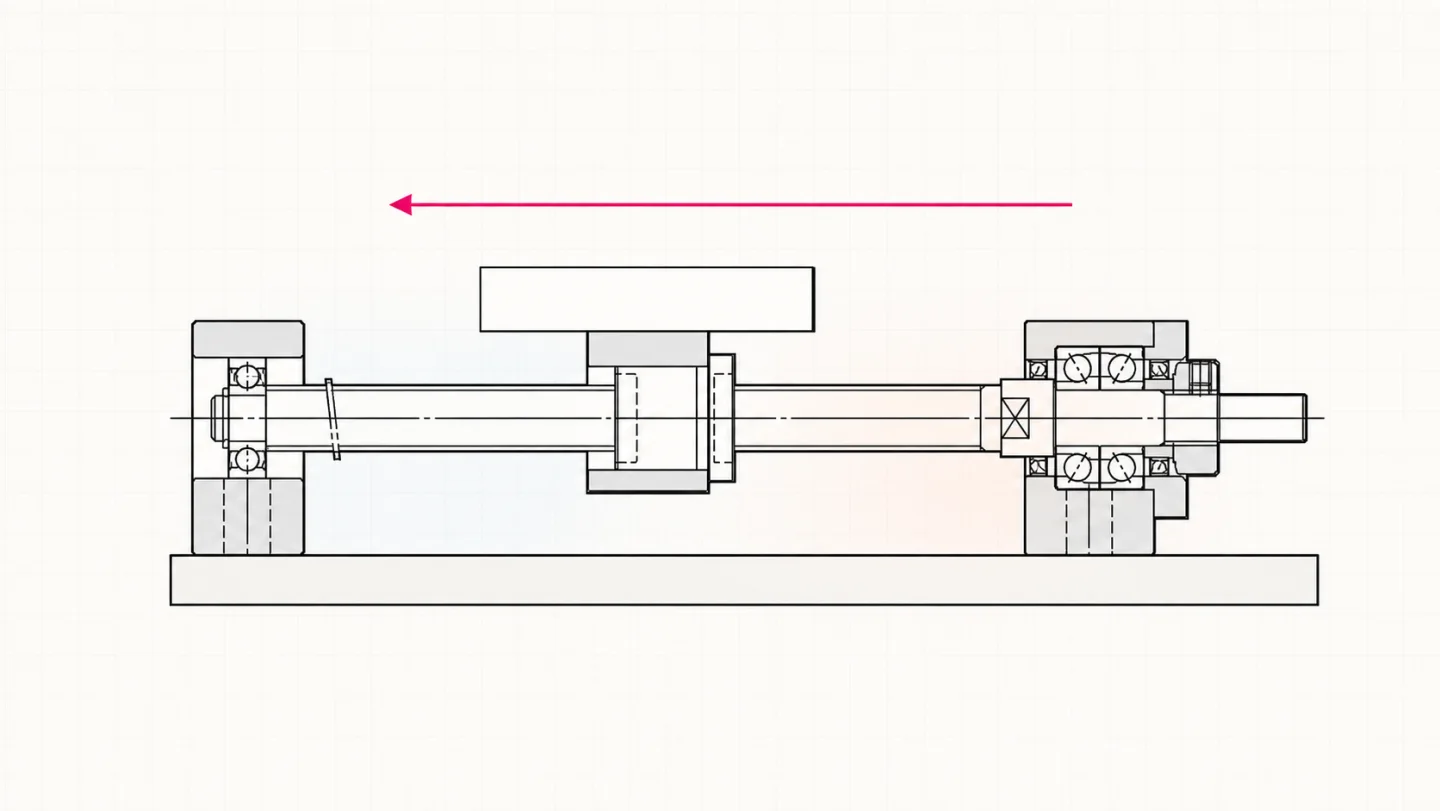
Rolling contact, support bearings, seals and grease all generate heat during operation. The fixed end establishes the axial datum, while the support end provides radial support within the machine's thermal-growth strategy.
01 / Sources and behavior
Thermal error is a system response to a temperature field
Rolling contact in a ball screw is not friction-free. Speed, preload, load, lubrication and seal drag determine heat generation, while the fixed-end bearing, coupling and motor can add heat to the shaft. Temperature is rarely uniform, so positioning drift may combine screw growth, base deformation and movement of the measurement datum.
Raceway contact, recirculation and preload create friction. High speed, excessive grease and contamination increase heat.
Preload, locking, seals and alignment affect friction and temperature. Abnormal heat calls for an assembly check.
Motor heat, machining heat, enclosure buildup, airflow and ambient changes all affect the temperature field.
Separate three patterns: error that grows with warm-up and recedes after cooling suggests thermal behavior; error repeating at the same position suggests lead or geometry; a step at reversal points toward backlash, axial play or locking.
02 / End restraint
Fixed-supported and fixed-fixed manage heat differently
Fixed-supported: the common general arrangement
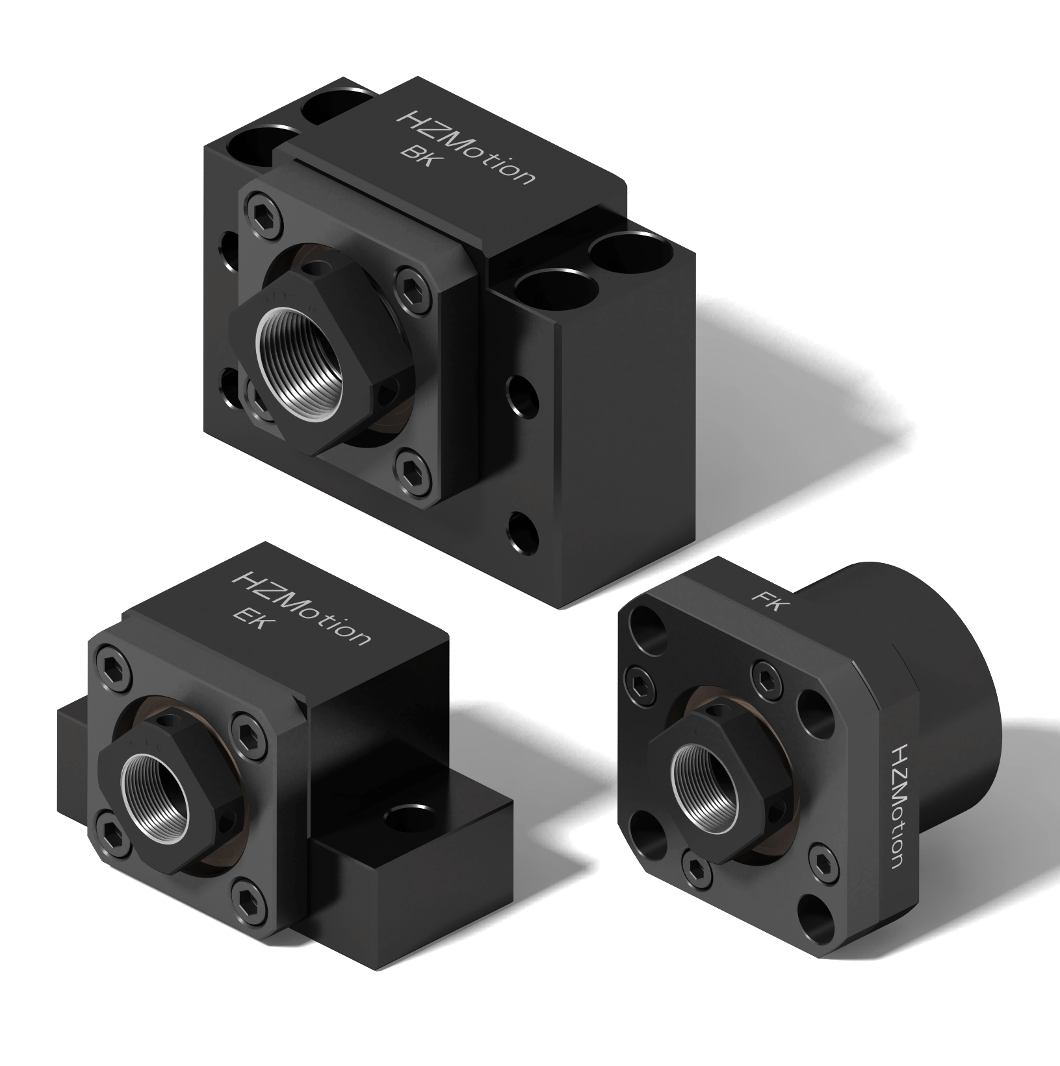
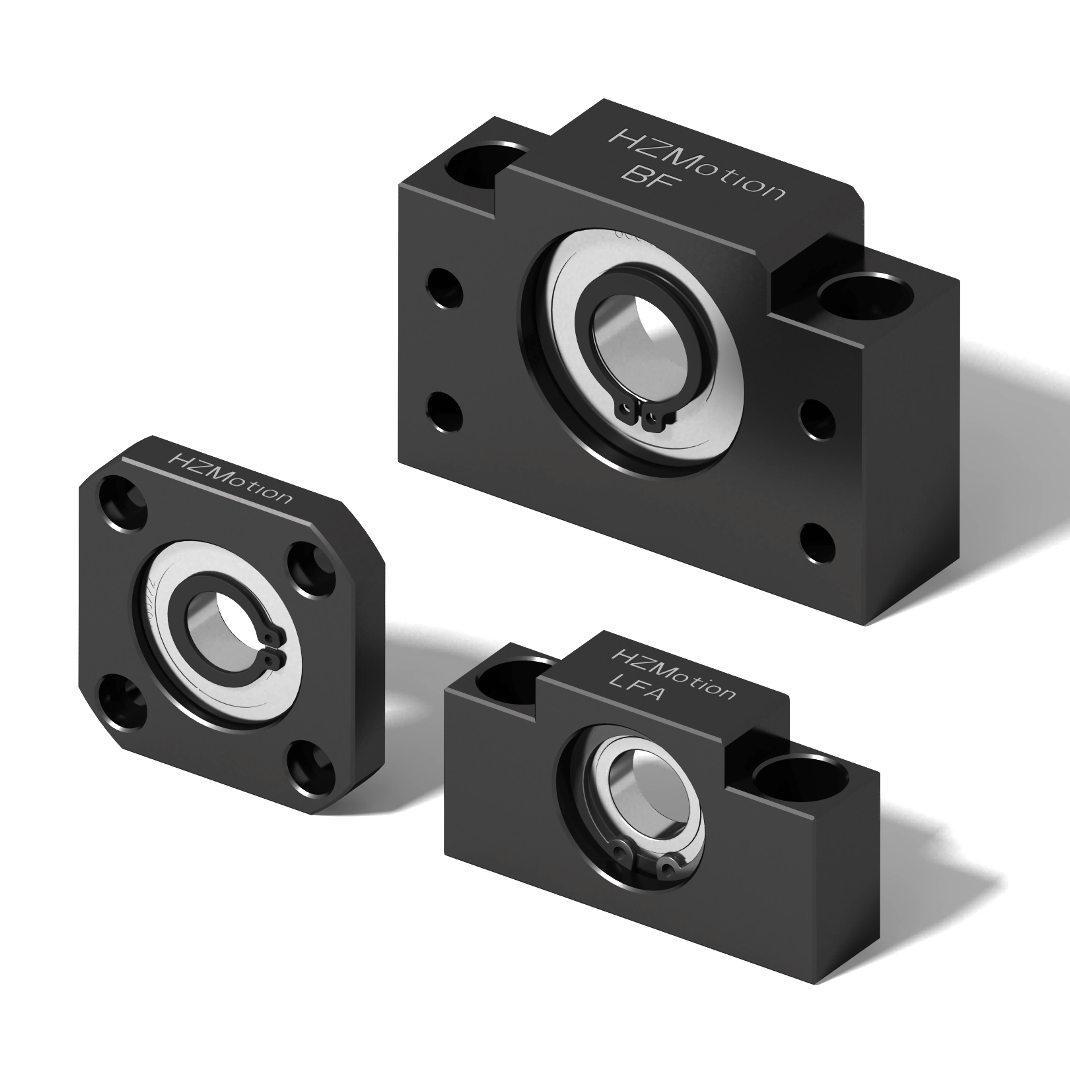
A preloaded bearing group at the fixed end establishes axial location and carries thrust. The support end mainly provides radial support. The HZMotion manual specifically states that the support end compensates for axial expansion and contraction caused by temperature rise and other factors.
Fixed-fixed: engineered restraint
Two fixed ends can improve critical speed and axial rigidity and can be used with deliberate pre-tension. Thermal growth then becomes additional axial load in the bearings and screw, so pre-tension, bearing configuration and temperature range must be calculated.
| Arrangement | Axial datum | Thermal strategy | Use and risk |
|---|---|---|---|
| Fixed-supported | Established by fixed end | Axial growth accommodated toward the support end | Clear function and good assembly tolerance for general automation |
| Fixed-fixed | Shared by both ends | Designed pre-tension and bearing elasticity absorb temperature change | Higher rigidity and critical speed, but more sensitive to datums, coaxiality and temperature |
| Unplanned double clamp | Undefined restraint | Growth becomes uncontrolled axial load | May produce excess heat, noise, torque and reduced bearing life |
03 / Quick estimate
Use linear expansion to check the order of magnitude
- ΔL
- Length change. If L is entered in mm, the result is in mm.
- α
- Coefficient of linear expansion; the exact value varies slightly with alloy and temperature.
- L
- Active length involved in thermal growth, not automatically stroke or total screw length.
- ΔT
- Average rise above the reference condition. A nonuniform field requires segmentation or measured compensation.
| Active length | Average rise | Estimated growth | Positioning meaning |
|---|---|---|---|
| 500 mm | 5°C | about 0.030 mm / 30 μm | Already significant in a precision error budget |
| 1000 mm | 10°C | about 0.120 mm / 120 μm | No longer a negligible amount |
| 1500 mm | 15°C | about 0.270 mm / 270 μm | Long, fast axes usually require thermal control, compensation or pre-tension |
Limit of the estimate: the table covers uniform material expansion only. It excludes nut position, base distortion, bearing elasticity and controller compensation and cannot replace a machine thermal-error test.
04 / Field diagnosis
Does the error change with time, position or direction?
| Observed pattern | First suspects | Verification | Do not start with |
|---|---|---|---|
| Correct cold, then gradually drifts during continuous operation | Screw, bearing or base temperature | Log screw, fixed-end and base temperature with position error | Moving the machine zero to hide drift |
| Similar error repeats at the same position | Lead error, straightness or calibration | Measure slowly by position and compare cold and warm curves | Adding preload as a universal cure |
| A fixed step appears at reversal | Backlash, axial play or loose locking | Repeat low-speed reversals and measure axial shaft movement | Calling every reversal step thermal growth |
| Heat appears with torque, noise and high bearing temperature | Misalignment, excessive clamping, lubrication or bearing damage | Stop and check smooth rotation, coaxiality and locking | Continuing to increase speed |
05 / Design and control
Reduce heat, then create a repeatable thermal condition
- Define the reference temperatureState whether calibration applies cold, after warm-up or at stable operating temperature.
- Control friction and lubricationMaintain lubrication, exclude contamination and excess grease, and correct assembly causes of abnormal heat.
- Use the right end pairingUse a matched fixed and support end for general service; fixed-fixed requires a full pre-tension and thermal-load design.
- Improve temperature uniformityManage enclosure airflow and nearby heat sources; consider screw or nut cooling when necessary.
- Standardize warm-upUse a repeatable speed and duty cycle and begin precision work after temperature and error rates stabilize.
- Compensate lastBuild compensation from measured temperature and position and retain limits for overheating and abnormal friction.
It must still provide stable radial support and the correct center height.
Excess pre-tension raises bearing load, friction and heat.
Misalignment, poor datums and incorrect locking create nonrepeatable error.
Long travel and local heat sources may require several sensors.
The HZMotion manual advises against casual disassembly of the fixed-end unit.
06 / Quick answers
Ball screw thermal-growth questions
Does the screw simply slide freely inside the support-end bearing?
No. The support end must first provide stable radial support. Its axial function works with the machine's growth strategy, and the exact floating interface follows the machined-end drawing and support-unit instructions.
Is fixed-fixed always more accurate than fixed-supported?
No. It can improve rigidity and critical speed, but insufficient datum accuracy, coaxiality, pre-tension control or thermal design can remove that advantage.
Can fixed-end temperature alone drive compensation?
It is useful but may not represent the average screw temperature. Long or locally heated axes benefit from additional points near the nut and base.
How long should warm-up take?
There is no universal time. Use the rate of temperature and positioning-error change under the real duty cycle as the stability criterion.